Toronto Catholic Schools: Check Admission Before You Buy the House
SCHOOL FIRST • TORONTO FAMILY HOME SEARCH
A 2026 guide to ratings, registration, boundaries and the questions worth asking before you make an offer.
Updated October 11, 2026 · By Kate Naccarato
You found the house. You found the school. You even checked the rating. Excellent. Now for the slightly less photogenic question: can your child actually attend?
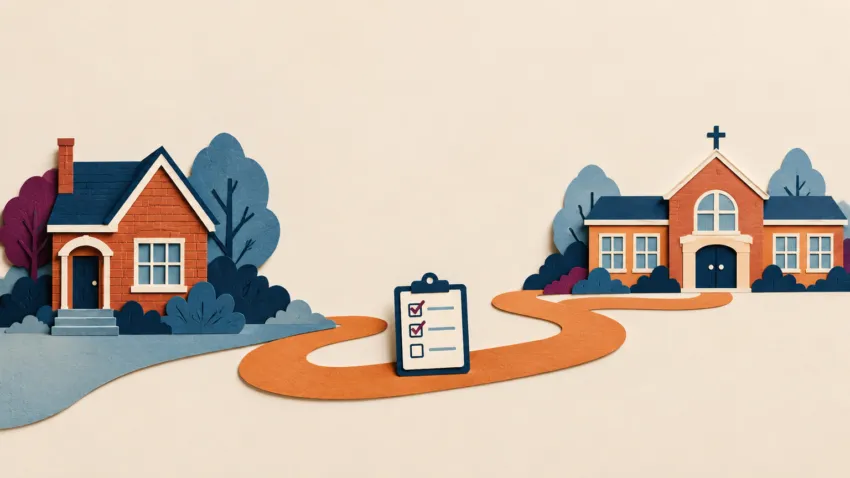
When families buy or move in Toronto, a nearby school can become a very expensive assumption. The useful order is eligibility, placement, program, daily routine-then the house. A score helps you ask questions. It does not reserve a desk.
First, which Catholic school system?
This guide focuses on the Toronto Catholic District School Board (TCDSB), the English-language Catholic board. French immersion within TCDSB is different from attending a French-language Catholic school through Conseil scolaire catholique MonAvenir, which has its own language and admission process. Check MonAvenir elementary admission or secondary admission separately.
Elementary and high school: different admission rules
| Stage | What families need to know |
|---|---|
| Elementary, including kindergarten | Eligibility can include a Catholic child, a non-Catholic child with a Catholic parent living in Toronto, and specified RCIA/RCIC pathways. Recognized Christian Orthodox child/parent pathways also appear in board policy. Ask Admissions to assess your documentation. |
| Secondary | Toronto residents may apply without being baptized Catholic. Ontario residents outside Toronto may apply, but admission depends on space. |
| Specialty programs | A regular school application is not the same as admission to an arts, IB or other specialty program. Separate criteria and application steps may apply. |
Sources: TCDSB elementary admission policy S.A.01, elementary registration, secondary registration and specialized programs.
The elementary webpage describes the Orthodox route more narrowly than the policy, which explicitly includes qualifying parents. It also puts Orthodox placement after Catholic applicants, subject to space. If that route applies to your family, get a written assessment from Admissions rather than interpreting the wording yourself.

The address check: a map is the start
Enter the exact prospective address in the official TCDSB Elementary School Locator. The board warns that boundaries and address information can change and asks families to confirm eligibility with the school before acting.
TCDSB says all its elementary schools have fixed boundaries, but living inside one does not guarantee a place. Out-of-boundary requests can involve a waitlist; an alternative school may be offered when the requested one cannot accommodate the child. Consult the current placement guidance.
For a buyer, my practical recommendation is to email the school and Admissions with the address, grade, program and intended start date. Ask whether the answer is a boundary confirmation, an eligibility assessment or an actual placement offer. Those are different answers.
School ratings: read the year before the score
EQAO and Fraser are not the same thing. EQAO publishes assessment results. Fraser creates its own rating and ranking from selected academic indicators. Neither tells you everything about teaching, belonging, support or whether your child will enjoy being there.
| Source | Underlying assessment year | Publication/release date | What it provides |
|---|---|---|---|
| EQAO results | 2025-26 | September 25, 2026 | Subject-level assessment results, not a 10-point school ranking. |
| Fraser elementary report, titled 2025 | 2023-24 | January 8, 2026 | Rating out of 10; 3,052 ranked schools. |
| Fraser secondary report, titled 2025 | 2023-24 | November 27, 2025 | Rating out of 10; 747 ranked schools. |
Selected Toronto Catholic school ratings
These are examples for research, not an exhaustive "best schools" list. Both tables use Fraser's 2025 editions and 2023-24 data. The rank is province-wide, with ties.
| School name in report | Rating /10 | Rank /3,052 |
|---|---|---|
| St Sebastian, Toronto | 10.0 | 1 (tied) |
| Our Lady of Perpetual Help, Toronto | 9.7 | 42 (tied) |
| St Michael's Choir, Toronto | 9.6 | 51 (tied) |
| St Edward, Toronto | 9.0 | 110 (tied) |
Source: original Fraser elementary report, printed pages 10-11.
| School name in report | Rating /10 | Rank /747 |
|---|---|---|
| St Michael's Choir, Toronto | 10.0 | 1 (tied) |
| Cardinal Carter-Arts, Toronto | 9.3 | 8 (tied) |
| Bishop Allen, Toronto | 8.7 | 33 (tied) |
| Father John Redmond, Toronto | 8.6 | 39 (tied) |
Source: original Fraser secondary report, printed pages 10-11.
Selective programs deserve particular care when comparing results. Cardinal Carter requires an audition; its Grade 7 entry also follows elementary admission requirements. Buying nearby does not substitute for that process. See Cardinal Carter's current admissions page and the board's arts program guidance.

What the newer EQAO release says
For context, the 2025-26 Ontario English-language results report Grade 3 math at 65%, Grade 6 math at 52% and Grade 9 math at 59% meeting the provincial standard. First-time eligible OSSLT writers had an 86% success rate. These are provincial figures-not TCDSB or individual-school results. Read the September 25, 2026 release.
Use EQAO's "Find My School" tool to inspect your shortlist by subject and year. Ask about participation, cohort size, changes over several years and the school's response. A small cohort or different intake can affect comparisons. A ranking does not measure a neighbourhood's worth, forecast your child's outcome or establish a property's value.
Registration: get the paperwork and timing right
For elementary applications, prepare the documents listed by TCDSB:
- Birth certificate or other age evidence accepted under board policy.
- Relevant baptismal or RCIA/RCIC documentation.
- Two accepted proofs of residential address: one from List A (such as a lease or utility bill) and one from List B (such as an employer record or insurance policy).
- Passport/immigration documents where applicable; contact Admissions about circumstances requiring assistance.
Upload documents through the application process and retain originals. Vaccination information is provided directly to Toronto Public Health. TCDSB also states that otherwise eligible children are not excluded because their parents lack immigration status. Registration requirements · Accepted address evidence.
For a move, also have recent report cards, school contact information and any relevant support plans ready. Ask the receiving school which records it needs; this is a preparation checklist, not a substitute for its document requirements.
| Situation | Next step |
|---|---|
| Secondary entry in September 2027 | Apply by October 30, 2026. Specialty applications close at 11:59 p.m.; later regular applications go directly to a waitlist. |
| Secondary open houses | The board announced events October 1-22, 2026. Confirm the date for your chosen school. |
| Moving during 2026-27 | Contact the secondary school directly for a current-year place. For elementary, contact the school/Admissions about the current application and capacity. |
| Kindergarten planning | The board says registration starts in January and continues through the year. Its current page covers 2026-27; a specific 2027-28 opening date was not verified for this update. |
Sources: secondary deadlines, September 3, 2026 open-house announcement, current portal and kindergarten guidance.
French, arts and other programs: check the actual entry route
TCDSB French immersion begins in Junior Kindergarten; Extended French begins in Grade 5. Core French is a different program. Confirm the receiving school, entry grade, available places and continuation route before choosing a property. The board's French program page currently says busing is not provided for French immersion or Extended French. Official French program information.
For arts, IB, Advanced Placement or a particular course pathway, ask what is actually offered at that school and how students enter it. An attractive program name on a school profile is not a confirmed place or course timetable. IB applications are handled directly by the participating schools; consult TCDSB's secondary registration guidance.
Check the school day, not just the school name
TCDSB's general elementary bus guidance uses a 1.5 km distance requirement plus an approved transportation area. Do not treat distance alone as qualification, especially for a different program or an out-of-boundary school. Confirm your exact circumstances with the school/Toronto Student Transportation Group. Transportation guidance.
Walk the route at pickup time. Check crossings, transit connections, before-and-after-school care, its hours and its waitlist. Having child care in the building is not the same as having a child-care space.
If your child needs learning or accessibility supports, arrange a conversation with the principal before the move. Discuss existing assessments, the Individual Education Plan (IEP), transition planning and whether an Identification, Placement and Review Committee (IPRC) process is relevant. Ontario's special education guidance, updated September 1, 2026, explains the routes; TCDSB Special Services can guide board-specific questions. A high score does not answer whether the support your child needs is available in that setting.
Before you buy: save this checklist
- Confirm the correct board and your child's admission eligibility.
- Check the exact address, grade, program and intended start date.
- Ask about capacity, waitlists, alternatives and any planned boundary changes.
- Verify application deadlines and obtain a written explanation of placement status.
- Check the assessment year behind every rating you use.
- Discuss support needs, child care and the real daily commute.
- Ask yourself whether the home still works if the preferred school is unavailable.
That final question matters. A lovely kitchen is a lovely kitchen. It cannot fix a school plan that only works if three unconfirmed things happen.
Use my home-buying resources alongside this checklist. If you are planning a move, send me your shortlist and your non-negotiables. We can build the home search around them while you confirm placement with the board.
What matters most for your family: the program, the support or the school run?