Toronto Rents Are Rising Again. Isn’t Winter Supposed to Be Cheaper?
Updated November 12, 2026 · By Kate Naccarato
Winter is usually when Toronto’s rental market takes a breath. Fewer moves, fewer showings, and sometimes a little more room to negotiate.
So why are we suddenly seeing reports that rents are going up?
The number of rentals available to choose from has been shrinking relative to leasing activity. That can make the market more competitive, even as the busy moving season winds down.
But before anyone declares that every Toronto landlord can raise their asking price, let’s look at what the numbers actually say.
Are Toronto rental prices really going up?
There are signs of a rebound, although they depend on what you measure.
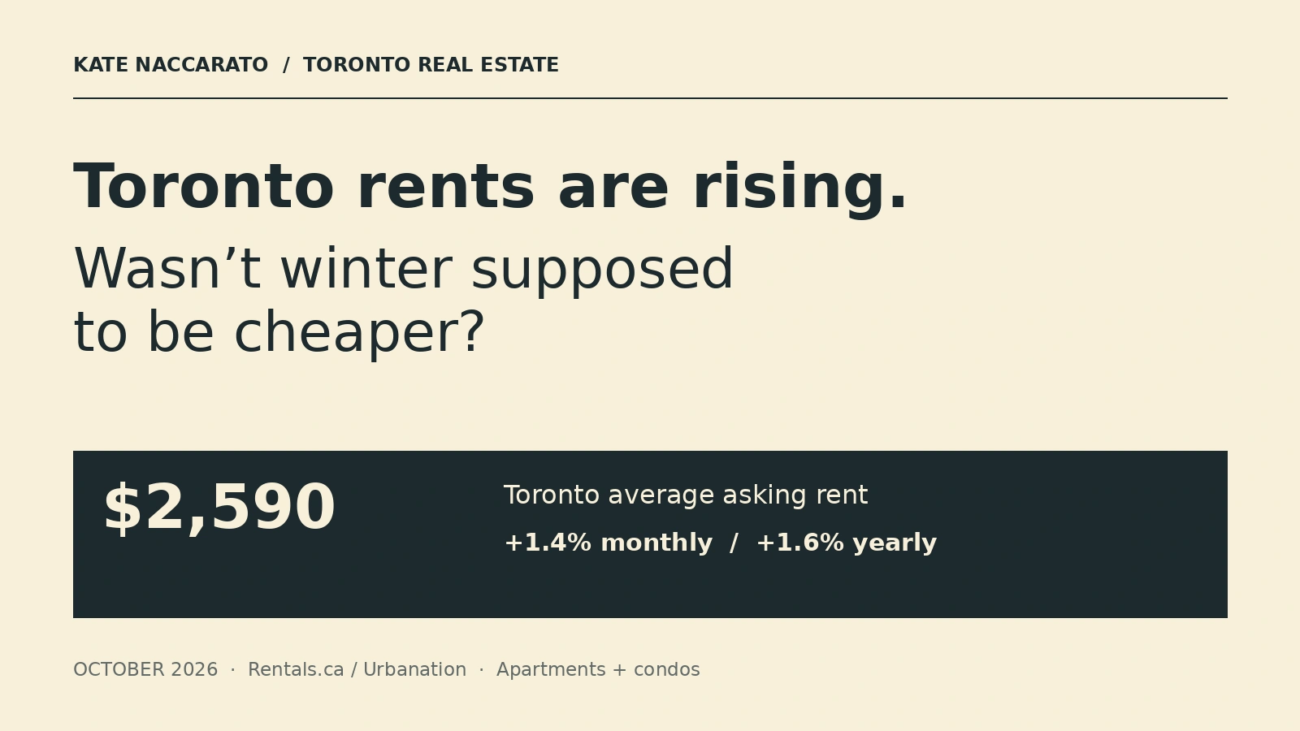
The November Rentals.ca and Urbanation report puts Toronto’s average apartment and condo asking rent in October 2026 at $2,590. That is up 1.4% from September and 1.6% from October last year, ending 32 consecutive months of annual declines.
The rebound is not evenly shared. Two-bedroom asking rents were up 2.8% year over year and three-bedrooms were up 4.3%. One-bedrooms were still down 1.2%. Several surrounding markets, including Mississauga, Vaughan and Markham, remained below their year-earlier levels.
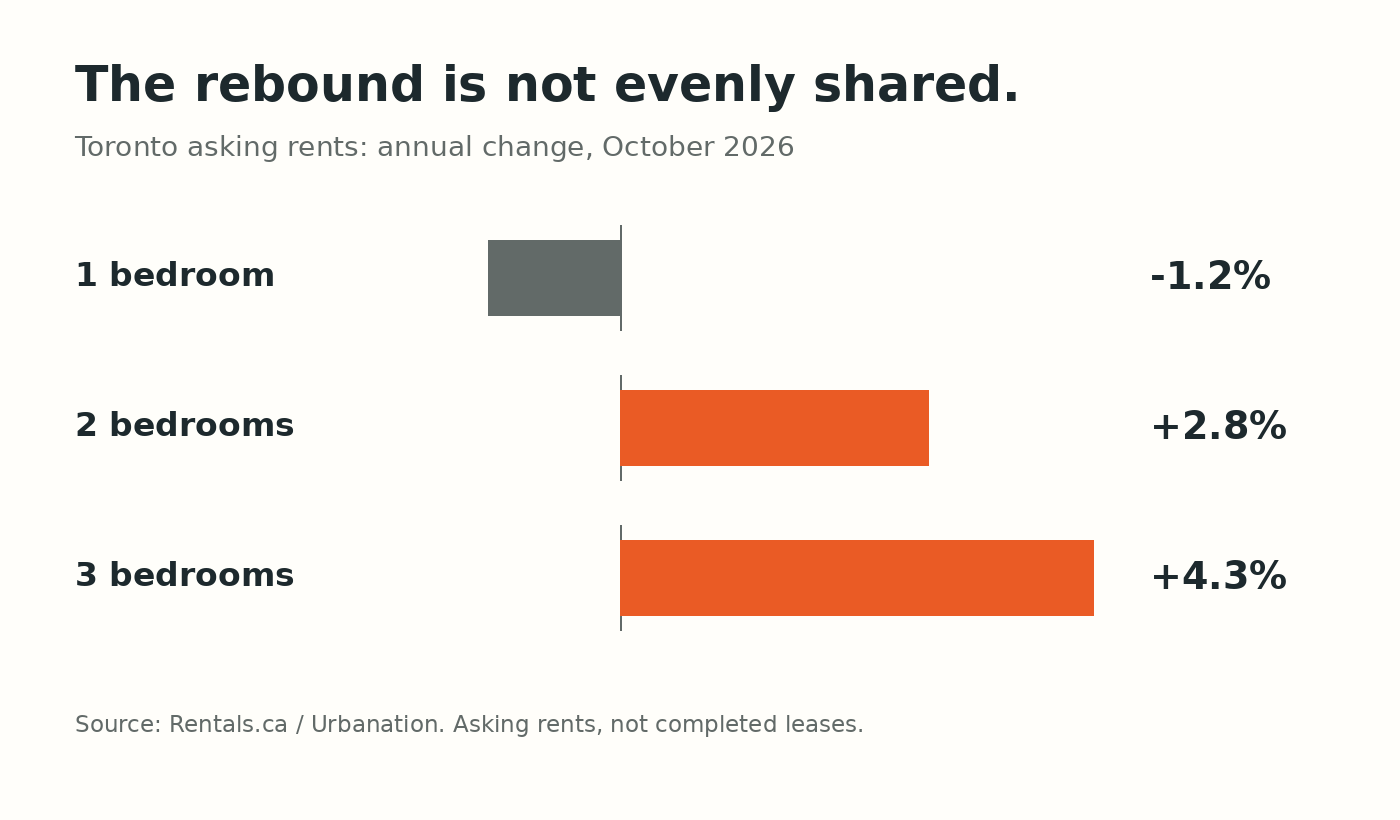
That distinction matters. These are advertised rents, not necessarily what tenants ultimately agreed to pay.
For another perspective, Valery’s November GTA rental report puts the average completed MLS condo lease in October at $2,633, down 0.2% year over year. Essentially flat.
That is a different geography and property sample from Toronto apartment and condo asking rents. Both findings can be true. One citywide average cannot price your apartment.
The available supply is getting thinner
The strongest evidence behind the shift is a change in the balance between available rentals and leasing activity.
Urbanation’s Q3 2026 GTHA rental report found active condo rental listings were down 25% year over year. Leasing growth had outpaced listing growth for five consecutive quarters.
In plain language: when renters have fewer suitable alternatives, there is less room to wait a landlord out.
In the purpose-built rental market, the share of projects offering incentives fell from 67% in Q2 to 60% in Q3. One free month replaced two free months as the most common incentive.
Same asking rent. Different bill.
A rental can become more expensive without the advertised monthly price changing.
A hypothetical $2,800-per-month apartment:
Two free months: $28,000 in first-year rent.
One free month: $30,800 in first-year rent.
The headline rent is identical. Your bank account notices the difference.
Compare the full first-year cost, including parking and utilities, and read the written incentive terms. This example is illustrative, not an advertised offer.
There is still choice in the market. Urbanation’s 3% vacancy figure covers stabilized purpose-built buildings. Including buildings still leasing up, its measure was 13.3%. Quoting only the smaller number would miss part of the story.
Why did rents soften in the first place?
CMHC’s 2026 mid-year rental market update describes how new supply and a surge in completed condos gave renters more choice earlier in the year. Some condos that did not sell also entered the rental market.
More competition between landlords can mean lower asking rents or more generous incentives. But the effect is not the same everywhere. Newer, higher-priced units can take longer to lease while older or family-sized rentals remain tighter.
A lot of advertised rentals does not necessarily mean a lot of suitable rentals. A family needing a second bedroom cannot solve that problem with a discounted studio.
Isn’t slower immigration supposed to reduce demand?
Slower population growth reduces one source of demand pressure. It does not remove the need for housing among people already here.
Statistics Canada’s Q2 2026 population estimates show Ontario’s population grew by 0.1% that quarter, while its non-permanent resident population declined by 1.5%. That provincial data does not support explaining the rebound as a fresh population surge.
CMHC points to possible demand supports such as young adults forming households, improved rental affordability after earlier declines, and return-to-office requirements. These are possible influences, not a calculation of exactly what caused October’s rent increase.
People still move out of their parents’ homes, separate, relocate for work and need different-sized homes. Rental demand is not one single immigration number.
What about all the new buildings?
Urbanation reported 34,545 purpose-built rental units under construction across the GTHA in Q3 2026. At the same time, condo units under construction had fallen 38% year over year to 35,920.
So the rental pipeline is growing while the condo pipeline is shrinking. Both matter, because condos also supply rental homes.
But a unit under construction is not an apartment you can move into today. These figures help explain future supply risks. They do not prove what your next lease will cost.
Will rents still fall this winter?
They might. The latest data does not settle that question.
Valery’s analysis of historical GTA condo MLS data reports median monthly rent changes of -1.5% in November and -1.6% in December, using 2012–2025 and excluding 2020–2021.
That is a brokerage’s historical analysis, not an official TRREB forecast or a promise of a discount.
The rental market has two clocks: the seasonal cycle and the broader supply-and-demand cycle. A November dip can happen at the same time as a year-over-year increase.
October asking rents do not tell us what November or December leases will cost. Q3 also includes busy-season activity. Fewer listings suggest tightening, but the data does not isolate one cause or prove every rental is worth more.
What renters should do now
Compare homes you would actually rent: similar neighbourhood, bedroom count, condition, parking, utilities and move-in date. Ask about incentives and calculate the total cost, not just the headline rent.
Have your application ready, but do not rush into a bad fit because of a headline. If your timing is flexible, winter may give you negotiating room. The calendar alone does not guarantee a deal.
What landlords should do now
A headline about rising rents is a reason to review your pricing, not pick a bigger number.
Look at recent comparable leases and the homes competing with yours today. Check how long they have been available and whether their prices have changed.
One empty month on a $2,800 rental costs $2,800. An extra $100 a month earns $1,200 over a year. Holding out can be expensive.
My take
After a period when renters had more choice, some segments are becoming more competitive. Larger units and some Toronto locations are showing more strength, while other areas remain softer.
I would take that shift seriously. I would not assume winter automatically means cheaper, or that every rental is suddenly worth more.
Toronto real estate rarely gives us one neat answer. Apparently that would be too convenient.
This article reflects the cited market reports available as of November 12, 2026. It is not a prediction of an individual property’s rent or advice on increasing rent in an existing tenancy. Rules for an existing tenancy are separate from market asking-rent trends.